Blog6 min read
How to ensure PPE compliance: AI helmet and vest detection
Why PPE rules slip, five ways to enforce them, and how AI helmet, vest and mask detection on existing CCTV works — accuracy, camera placement and rollout.

Arthbot team
Arthbot Systems, Haridwar
On this page
Every factory has a PPE rule. Most have signs, training records and a box of helmets at the gate. And most safety officers will tell you that on a hot afternoon, on a short job, or when nobody's looking, the rule slips.
Quick answer To ensure PPE compliance, combine four things: the right PPE that's comfortable enough to wear, clear zone rules, checks at entry points, and continuous monitoring on the floor with quick feedback. AI PPE detection on existing CCTV handles the monitoring: it checks every person in a zone for helmets, vests, masks or visors, alerts the supervisor with a snapshot when something's missing, and reports compliance by zone and shift.
Why PPE rules slip
- Discomfort. Helmets and masks are hot; people take them off "for a minute".
- Short tasks. "I'm only going in for two minutes" is how most violations start.
- Contractors and visitors who weren't in the induction.
- Inconsistent enforcement. If the rule is enforced on the day shift but not at night, it isn't really a rule.
- No feedback. Supervisors can't see every zone, so most violations are never noticed — and never corrected.
Five ways to enforce PPE
| Method | Covers | Strength | Weakness |
|---|---|---|---|
| Training and signage | Everyone, once | Sets the expectation | Fades without reinforcement |
| Gate checks by security | Entry only | Simple | Nothing after the gate |
| Supervisor rounds | Where the supervisor is | Immediate coaching | Can't be everywhere, every shift |
| Periodic audits | A sample | Formal record | A snapshot, not the reality |
| AI detection on CCTV | Every camera, every shift | Continuous, with evidence and trends | Needs camera coverage and someone to act on alerts |
The methods work best together: training sets the rule, AI detection finds where it's broken, supervisors coach, and audits confirm the trend.
How AI PPE detection works
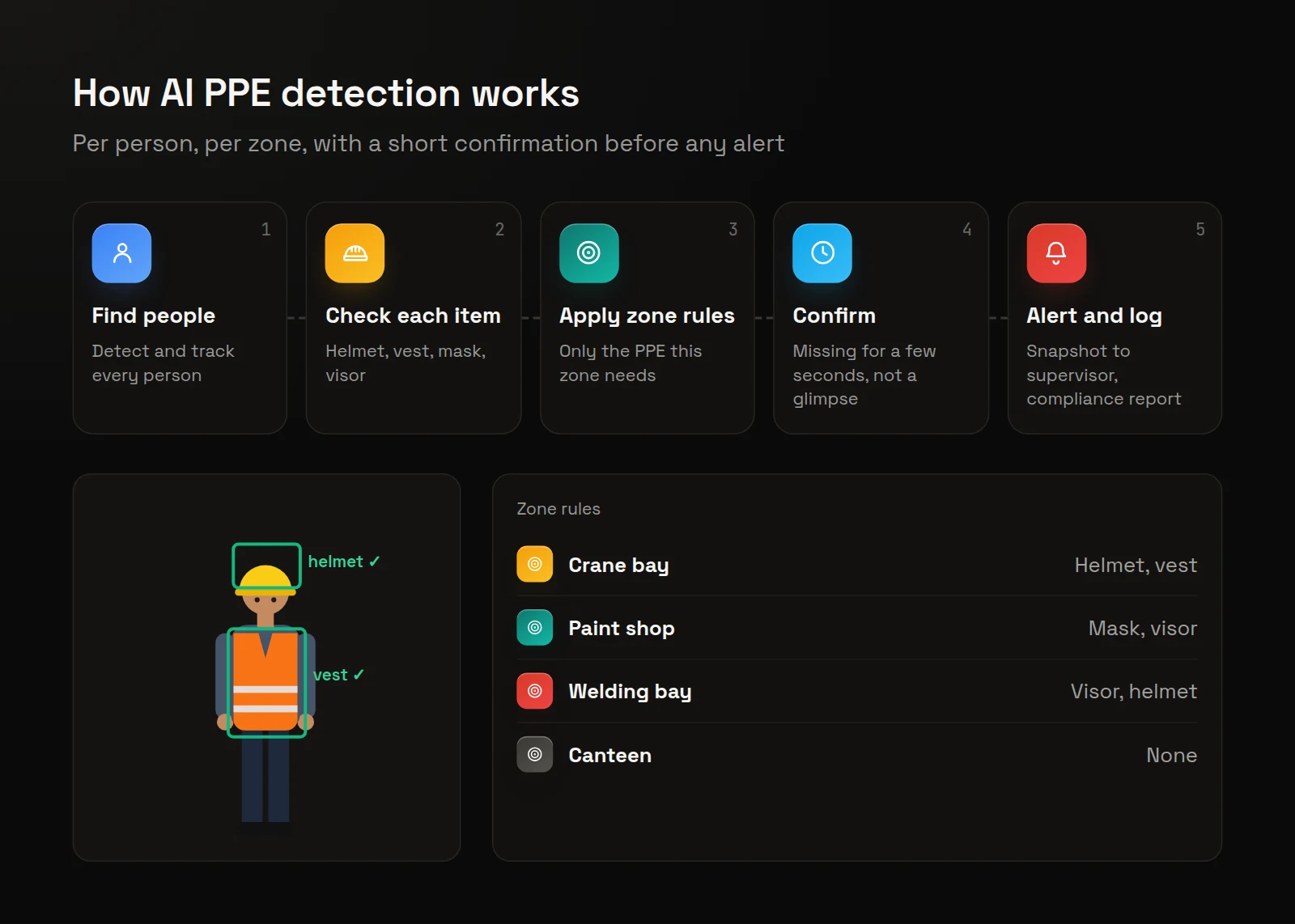
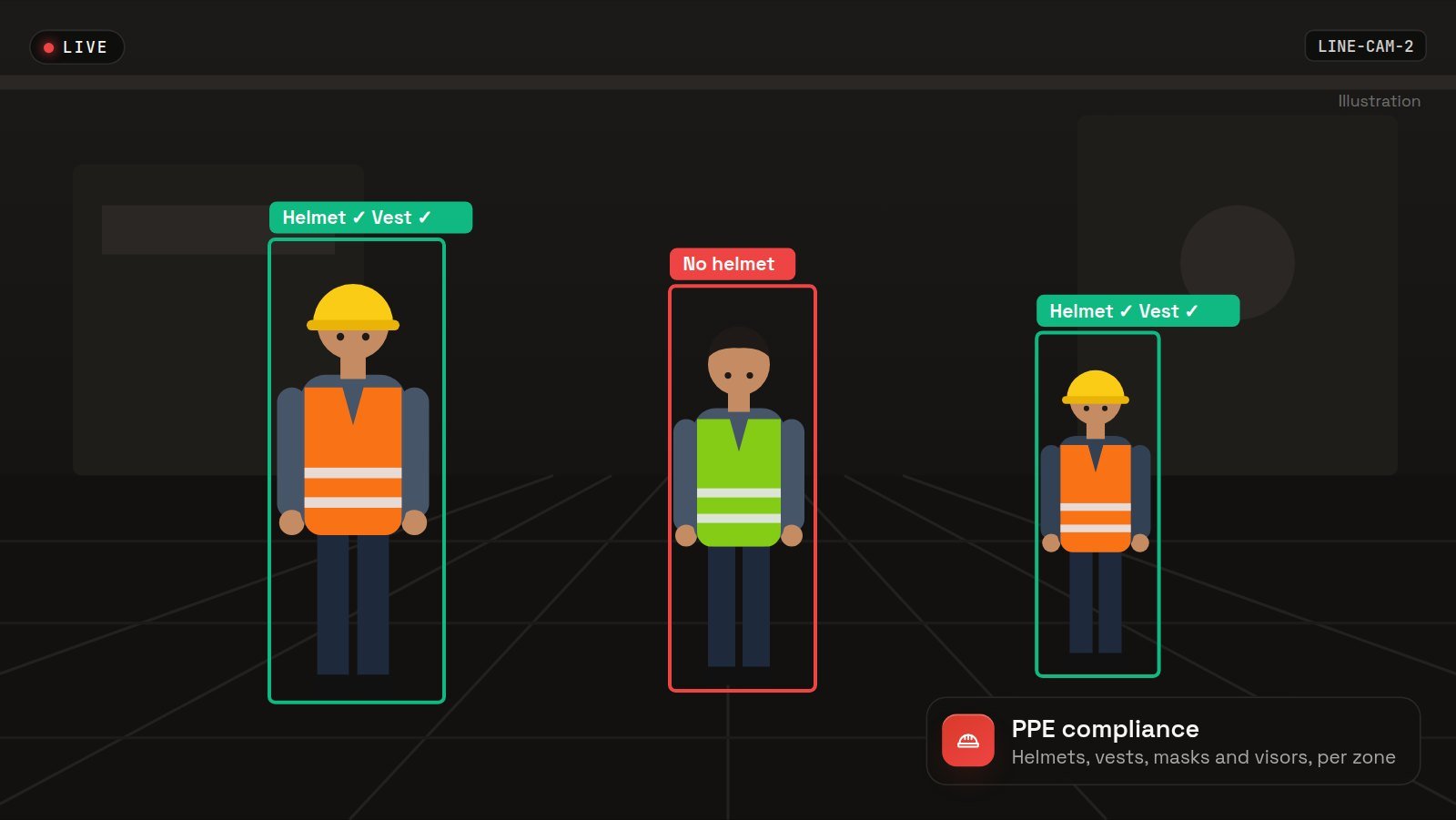
- Find people. A detection model finds every person in each frame and tracks them, so one person is one case, not a stream of duplicate alerts.
- Check each PPE item on each person: helmet, high-visibility vest, mask, visor or face shield. At height, a harness (see work-at-height safety).
- Apply the zone rules. A paint shop may need masks; a crane bay needs helmets; the canteen needs nothing. Each camera zone gets its own list, and its own schedule.
- Confirm before alerting. A violation must last a few seconds before it counts, which filters out a helmet that's briefly hidden behind a pillar.
- Alert and record. The supervisor gets a snapshot or clip; every event is logged with time and zone for the compliance report.
Arthbot's PPE compliance detection runs per zone on existing cameras and covers helmets, vests, masks and visors.
What decides accuracy
- Pixels on the person. The PPE needs to be big enough in the picture. As a rule of thumb, aim for at least the "observe" level of the CCTV pixel-density guidelines (about 63 pixels per metre) across the area, and the "recognise" level (125 px/m) at entry checkpoints. Our guide to DORI and pixels per metre shows how to work that out for each camera.
- Camera height and angle. A camera 3–5 m high, looking down at about 30°, sees helmets and vests well. A camera looking straight down sees helmets but not faces or vests; one at head height is blocked by the first person in line.
- Look-alikes. Caps, turbans, scarves and hair colour can resemble helmets; orange shirts can resemble vests. Good models are trained on these — test them on your footage, including your uniforms.
- Occlusion and crowding. People behind machines or each other are only partly visible; the confirmation time handles brief gaps.
- Lighting. Strong backlight and dark corners reduce accuracy; IR night images lose colour, which matters for vest detection.
Tip Put one camera on each entry into a PPE zone. Checking people as they walk in, at a short distance and a good angle, gives the most accurate results and stops violations before they spread across the floor.
Rolling it out
- Choose two or three high-risk zones where PPE is required and violations are common.
- Check the cameras see people at a usable size, and re-angle if needed.
- Set the rules per zone — which PPE, which hours — and who receives each alert.
- Run a two-week baseline with alerts off or to the safety team only. You'll get a true compliance rate and can tune the rules without flooding supervisors.
- Switch on alerts and coach on the spot. Expect compliance to rise quickly once people know violations are seen.
- Report weekly by zone, shift and contractor. Persistent problems usually point to something to fix: PPE that's uncomfortable, a station in the wrong place, a contractor who wasn't briefed.
Talk to your people first
PPE detection works best when workers know about it and understand why. Explain what's monitored (PPE in work zones), what isn't (the canteen, washrooms, identities in reports), who sees the alerts and how they're used — for coaching and fixing conditions, not for punishment. Under India's Digital Personal Data Protection Act, 2023, footage of identifiable people is personal data: keep it for a defined purpose, limit access and delete it on schedule.
PPE is one of the unsafe acts that leading safety programmes track — read unsafe acts vs unsafe conditions — and one of 12 real uses of AI in manufacturing. To see PPE detection on your own footage, book a demo.
Frequently asked questions
How do you ensure PPE compliance at work?
Provide the right, comfortable PPE; set clear rules for each zone; check people at entry points; monitor the floor continuously and give quick feedback; and review compliance by zone and shift. AI detection on CCTV makes continuous monitoring practical.
What is PPE detection?
PPE detection is AI video analytics that checks whether people on camera are wearing required personal protective equipment — such as helmets, high-visibility vests, masks and visors — and alerts supervisors when something is missing.
How accurate is AI helmet detection?
With well-placed cameras that show people at a usable size, AI helmet detection is highly reliable. Accuracy drops with distant or steeply angled cameras, crowding, look-alike headwear and poor lighting, so test on your own footage before rollout.
Can PPE detection work on existing CCTV cameras?
Yes, if the cameras see people at enough resolution — roughly 63 pixels per metre or more across the area, and more at entry points. Most factory cameras covering work areas and gates are suitable; some may need re-angling.
Is it legal to monitor PPE with cameras in India?
CCTV monitoring of work areas for safety is common in India. Because footage of people is personal data under the Digital Personal Data Protection Act, tell workers what is monitored and why, use the data for that purpose only, restrict access and delete it on schedule.
- PPE detection
- helmet detection
- worker safety
- factory
- EHS
See it on your own cameras
Send us a few minutes of your footage and we'll show you what Arthbot finds in it.