Blog6 min read
AI in manufacturing: 12 real uses on the factory floor
Twelve practical ways factories use AI on the cameras they already have, for quality, safety, flow and security, and how to pick the first one.

Arthbot team
Arthbot Systems, Haridwar
On this page
Most talk about "AI in manufacturing" is about robots, digital twins and predictive maintenance. The fastest wins in most Indian plants are simpler: the CCTV cameras already on the walls, watched by AI instead of nobody.
Quick answer On the factory floor, AI is used most for quality (defect detection, counting, SOP checks), safety (PPE, work at height, falls, fire and smoke, restricted zones), flow (material movement, dock turnaround, blocked aisles) and security (perimeter, gates, camera tampering). Most of these run on existing cameras with one GPU server. Start with the one problem that costs you most, on two or three cameras, and measure it for a few weeks.
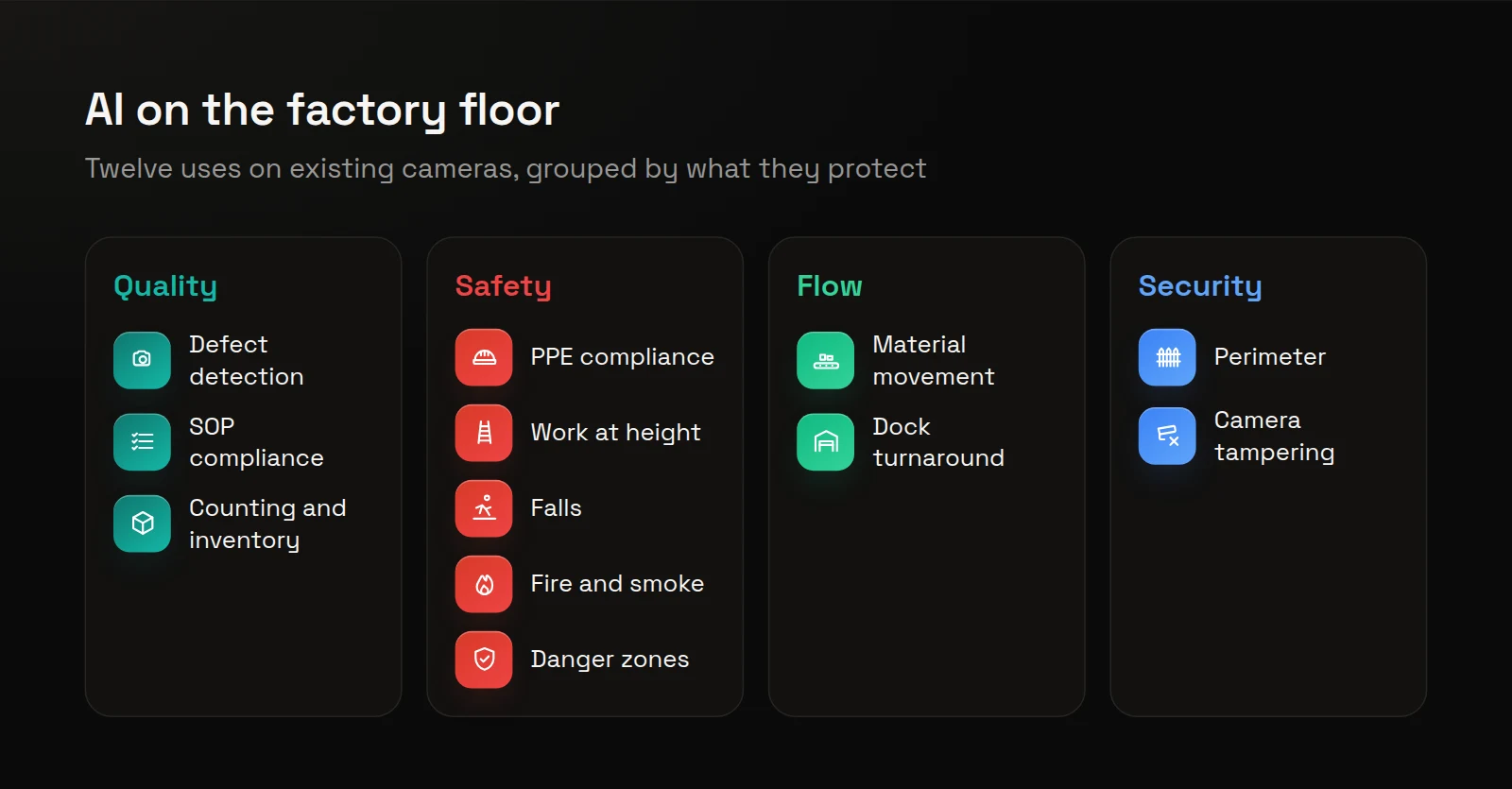
Quality
1. Defect detection on the line
Cameras over a conveyor or station check every unit for missing screws, misalignment, paint or surface defects, solder faults and damaged parts, and can flag the part or stop the line. Unlike a human inspector at the end of a shift, the camera looks at the hundredth part as carefully as the first. See defect detection and our comparison of manual vs AI visual inspection.
2. SOP compliance at workstations
AI checks that each step of a standard operating procedure happens, in the right order and within its time — at assembly stations, inspection points or hygiene stations — and flags skipped or out-of-order steps. See SOP compliance monitoring.
3. Counting and visual inventory
Counting cartons, bags or parts as they pass, or checking stock levels on racks from a camera, replaces manual tallies and catches mismatches early. See visual inventory and SKU counting.
Safety
4. PPE compliance
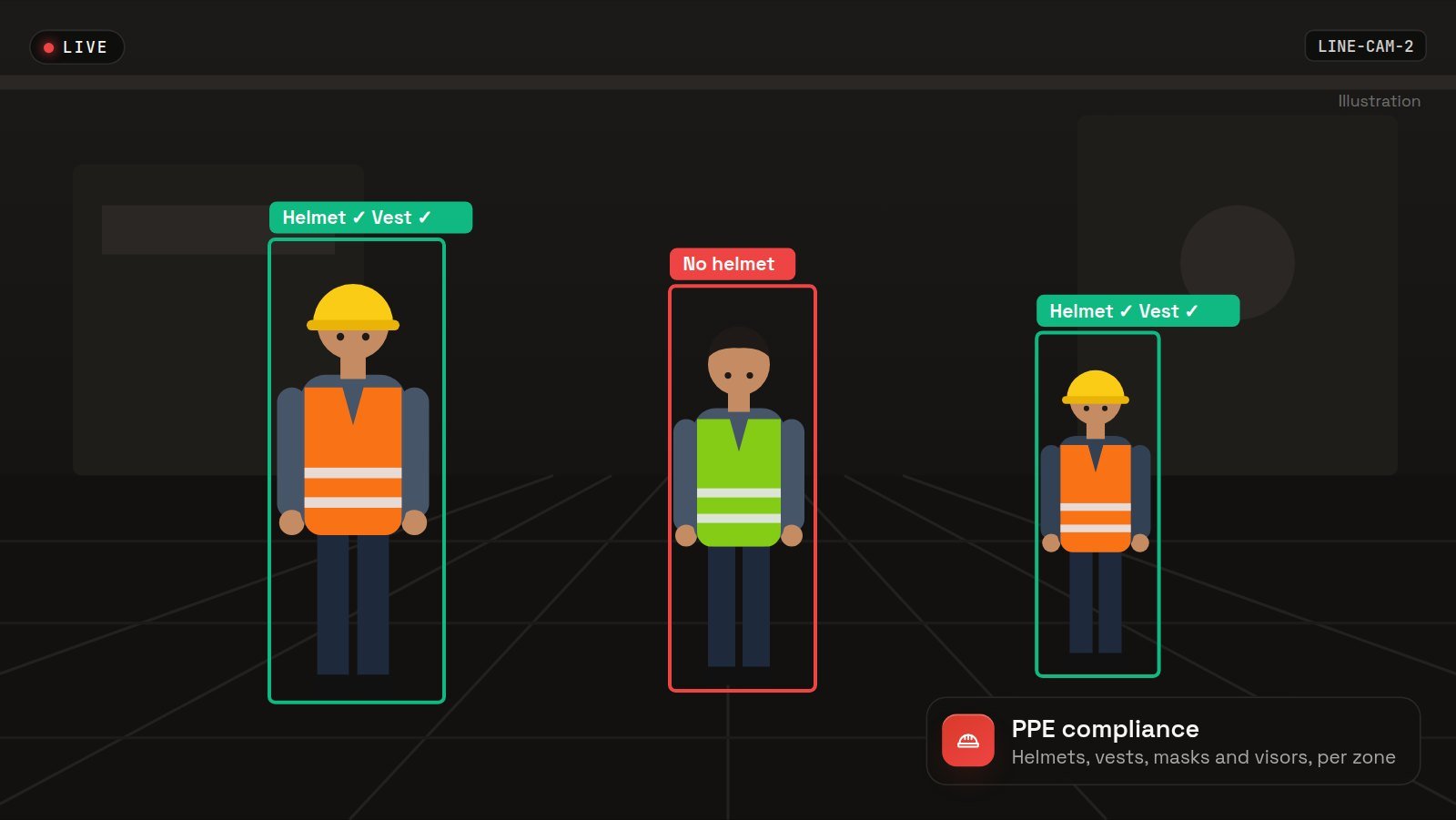
Missing helmets, vests, masks and visors are detected per zone, with an alert to the supervisor and a snapshot as evidence. It's the most common first project in Indian factories. Read how to ensure PPE compliance.
5. Work at height
Roofs, scaffolds and platforms are watched for people without a harness, outside permitted zones or outside permit hours. See work-at-height safety.
6. Falls and people down
A person who falls or is lying on the floor in a quiet corner of the plant triggers an immediate alert with a clip. See fall detection.
7. Fire and smoke
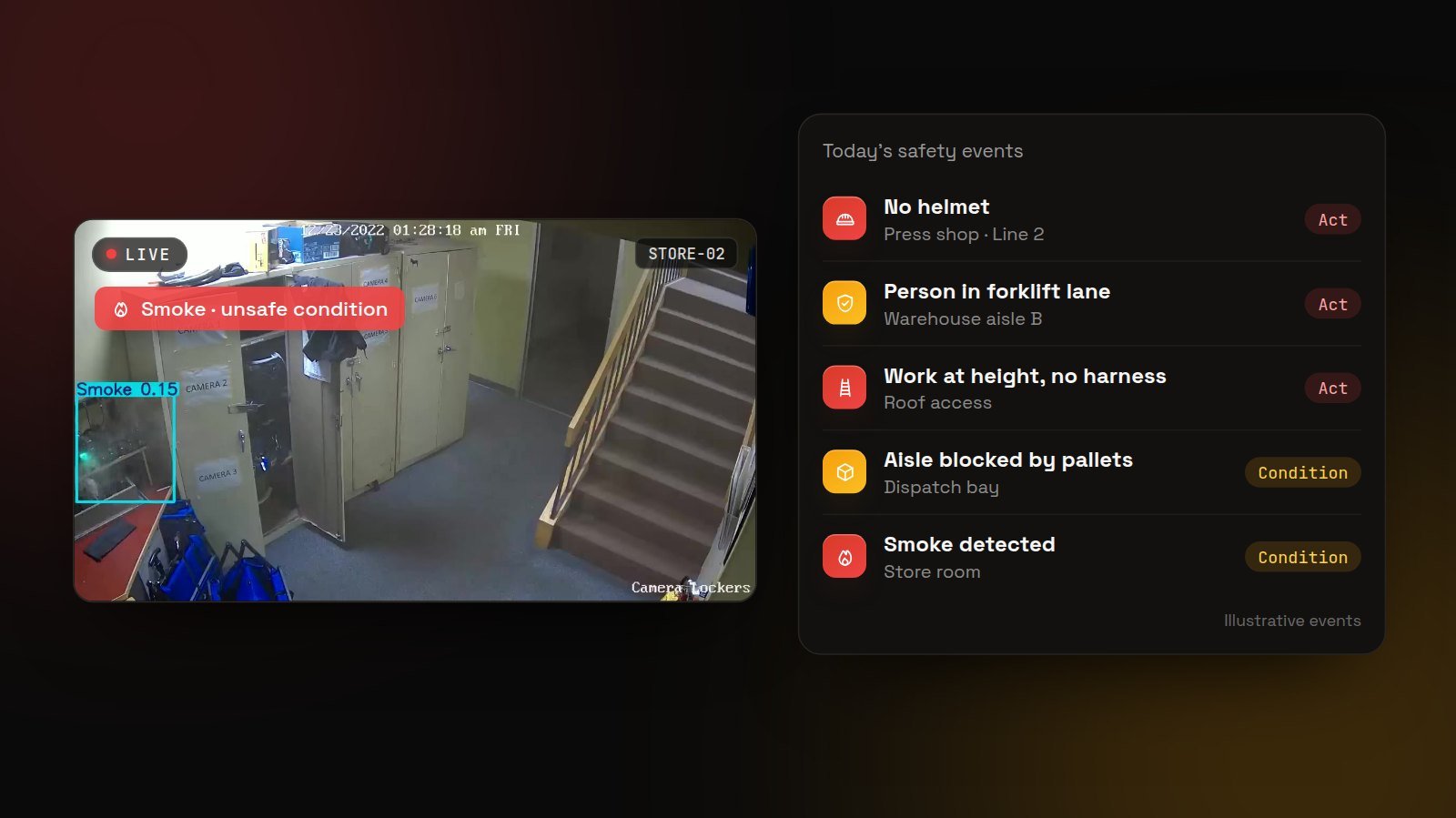
Smoke and flames in large spaces — warehouses, paint shops, scrap yards — are spotted on camera, often where ceiling detectors are slow to react. See fire and smoke detection.
8. Restricted and danger zones
People entering a robot cell, press area, forklift lane or electrical room raise an alert. See intrusion detection.
Together, these turn unsafe acts and conditions into data you can act on before someone gets hurt — read unsafe acts vs unsafe conditions.
Flow
9. Material movement and waiting time
Trolleys, bins, pallets and work-in-progress are followed between stores, stations and docks, measuring travel and waiting time and spotting blocked aisles. See material movement tracking.
10. Dock and truck turnaround
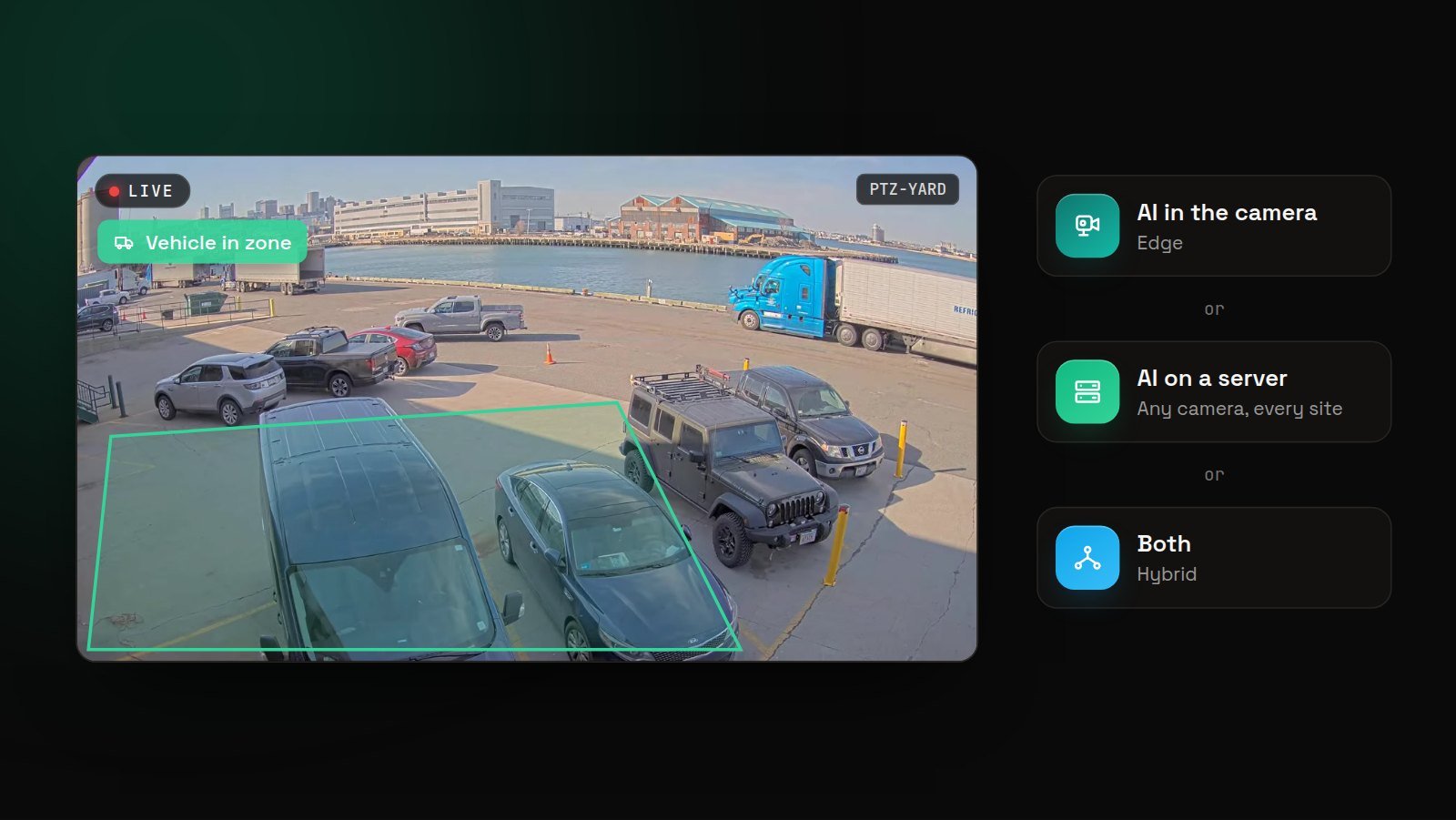
Cameras at the gate and docks log each truck's arrival, docking and departure, often by number plate, so you can see where loading time goes. See dock management and ANPR.
Security
11. Perimeter and after-hours intrusion
Fence jumping and people in the yard at night are detected with fewer false alarms than motion sensors, because the AI knows a person from a dog or a shadow. See perimeter and fence-jumping detection.
12. Camera tampering
A camera that's covered, sprayed, defocused or turned away raises an alert, so blind spots don't last until someone needs the footage. See camera tampering detection.
Which one first?
| Use | Pays off through | Cameras needed | First number to track |
|---|---|---|---|
| Defect detection | Less scrap, fewer returns | Dedicated, over the line | Defects caught per 1,000 units |
| SOP compliance | Fewer process escapes | Over workstations | Steps skipped per shift |
| PPE compliance | Fewer injuries, audit evidence | Existing, at entries and zones | Compliance rate by zone |
| Work at height / falls | Fewer serious injuries | Existing | Alerts per week, response time |
| Fire and smoke | Earlier response | Existing, high-risk areas | Time from first smoke to alert |
| Material movement | Less waiting, less WIP | Existing, along routes | Average waiting time per station |
| Dock turnaround | Faster loading, fewer detention charges | Gate and dock cameras | Truck turnaround time |
| Perimeter | Less theft | Existing, perimeter | Intrusions vs false alarms |
A practical rule: start where a problem is frequent, visible on camera, and already costing money — and where someone will act on the alert. A brilliant detection that nobody responds to changes nothing.
What it takes
- Cameras: most uses work on existing IP cameras that already see the area. Defect detection is the exception: it needs a camera and lighting chosen for the part.
- One server with a GPU: a mid-range NVIDIA GPU analyses about 250 frames per second on our deployments — around 50 cameras at five frames per second. Use our hardware sizing calculator for your numbers, or read AI CCTV camera or AI software?
- Someone who owns the alerts: a supervisor, safety officer or control room, with a clear response for each alert type.
- A pilot with numbers: two to four weeks on a few cameras, counting true and false alerts, before rolling out.
Seeing the whole plant at once
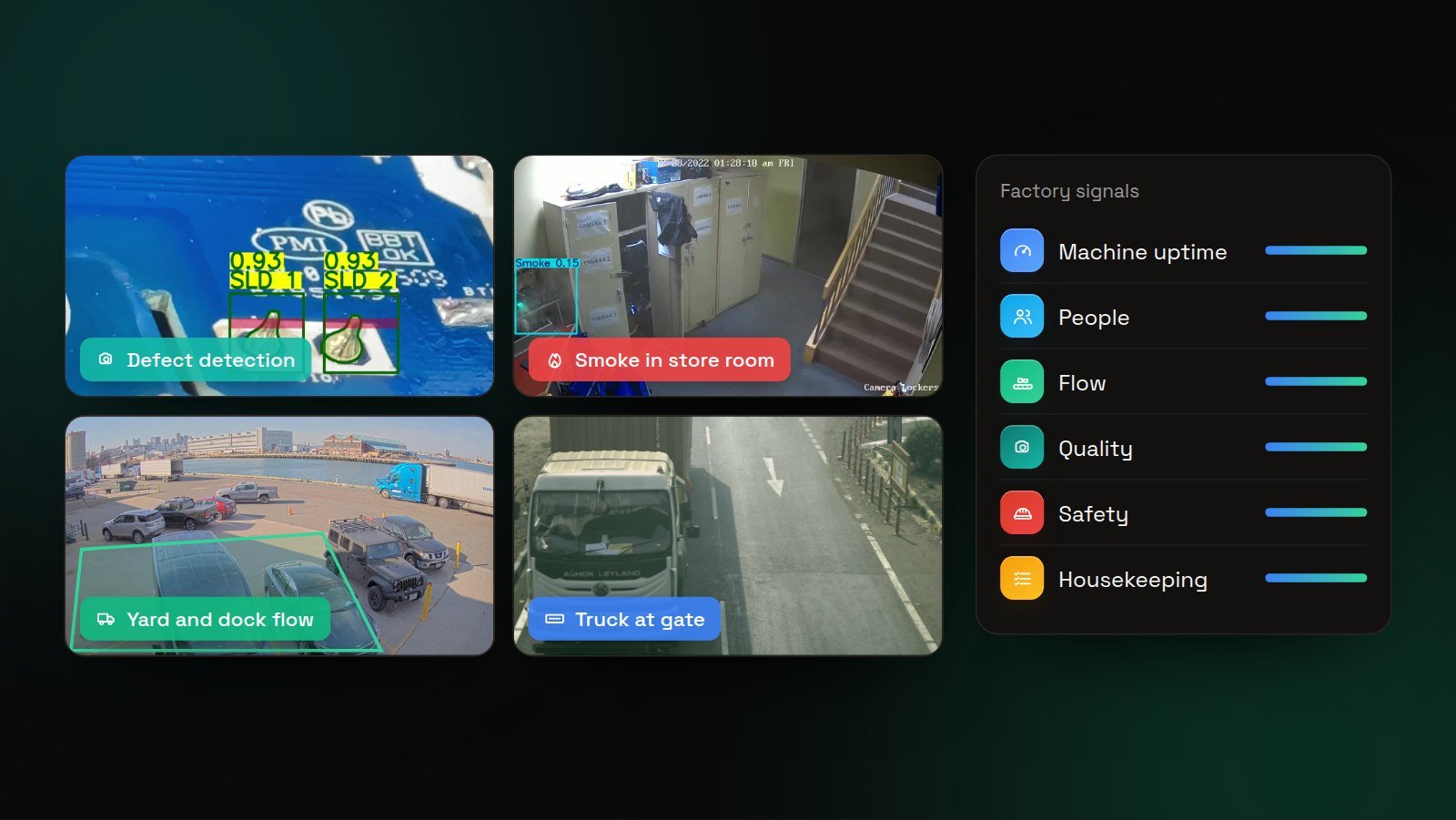
Individual detections are useful; a combined view is better. OCCULAX, Arthbot's industrial AI platform, connects to a factory's existing cameras and uses AI agents to watch six operational signals — machine uptime, people, flow, quality, safety and housekeeping — and combines them into a single Factory Health Score, with the areas to improve first.
If you're comparing approaches, read traditional factory monitoring vs AI factory intelligence, or see everything Arthbot does for manufacturing. To try it on your own floor, book a demo with a few minutes of footage.
Frequently asked questions
How is AI used in manufacturing?
On the factory floor, AI analyses camera video to catch defects, check that procedures are followed, enforce PPE and safe zones, detect falls, fire and smoke, track material movement and truck turnaround, and secure the perimeter. It also powers predictive maintenance and planning, but camera-based uses are usually the quickest to deploy.
Can AI work with my factory's existing CCTV cameras?
For most safety, flow and security uses, yes. AI software analyses the video from existing IP cameras over RTSP or ONVIF. Defect detection on fast production lines usually needs a dedicated camera and lighting.
How much does AI in a factory cost?
It depends on the number of cameras, the uses and whether new cameras are needed. Hardware is often modest: one mid-range GPU server can analyse around 50 cameras at five frames per second. Software is usually licensed per camera or per use. Ask for a quote for your site.
What is the best first AI project for a factory?
Pick a problem that happens often, is visible on camera and already costs money — PPE compliance, a recurring quality defect or slow truck turnaround are common choices. Pilot it on two or three cameras and measure results before expanding.
Does AI replace safety officers or quality inspectors?
No. It watches continuously and flags what needs attention, so safety officers and inspectors spend their time acting on problems rather than searching for them.
- AI in manufacturing
- factory
- quality
- worker safety
- OCCULAX
See it on your own cameras
Send us a few minutes of your footage and we'll show you what Arthbot finds in it.