Blog8 min read
Unsafe acts vs unsafe conditions: examples and near misses
The difference between unsafe acts, unsafe conditions and near misses, with factory examples, the safety triangle, the KPIs that matter and how cameras help.

Arthbot team
Arthbot Systems, Haridwar
On this page
Every serious accident in a factory is preceded by smaller things that went wrong and didn't hurt anyone — yet. Telling unsafe acts from unsafe conditions, and catching the near misses between them, is how safety teams get ahead of injuries instead of investigating them.
Quick answer An unsafe act is something a person does that creates risk — not wearing a helmet, walking through a forklift lane, bypassing a guard. An unsafe condition is something about the workplace that creates risk — a blocked exit, an oil spill, a missing machine guard. A near miss is an event that could have caused injury or damage but didn't. Accidents usually happen where unsafe acts meet unsafe conditions, so safety programmes track all three.
Unsafe act vs unsafe condition
| Unsafe act | Unsafe condition | |
|---|---|---|
| What it is | A person's behaviour that creates risk | A state of the workplace that creates risk |
| Who causes it | The person doing the work | Equipment, layout, housekeeping, management |
| Example | Working at height without a harness | A scaffold without a guardrail |
| Example | Not wearing a helmet in a helmet zone | Falling-object risk under a crane path |
| Example | Walking through a forklift lane | No marked pedestrian walkway |
| Example | Bypassing a machine guard | A guard that's missing or broken |
| Example | Smoking near flammables | Leaking solvent drums |
| Usual fix | Training, supervision, feedback | Engineering, maintenance, housekeeping |
The two feed each other. A missing walkway (condition) invites people to cut across the forklift lane (act); a guard that slows production (condition) invites people to bypass it (act). That's why fixing one side alone rarely works.
Common unsafe acts in factories
- Not wearing required PPE — helmet, vest, gloves, goggles, mask
- Working at height without fall protection
- Entering restricted zones: robot cells, press areas, electrical rooms
- Walking in forklift and vehicle lanes, or riding on forks
- Bypassing guards, interlocks or lockout–tagout
- Using phones while operating machinery or driving
- Lifting incorrectly, or more than the safe limit
- Horseplay, running, taking shortcuts
Common unsafe conditions
- Blocked aisles, exits and fire equipment
- Spills, wet floors and loose material on walkways
- Missing or damaged guards, railings and covers
- Poor lighting and visibility at crossings
- Overloaded racks, unstable stacks
- Exposed wiring and overloaded sockets
- Smoke, fumes or dust without extraction
What is a near miss?
A near miss is an unplanned event that didn't cause injury, illness or damage — but could have. A pallet falls where someone was standing a second earlier; a forklift brakes hard for a pedestrian who stepped out between racks. Near misses are free lessons: they show exactly where the next accident is likely to happen.
How many near misses before an accident?
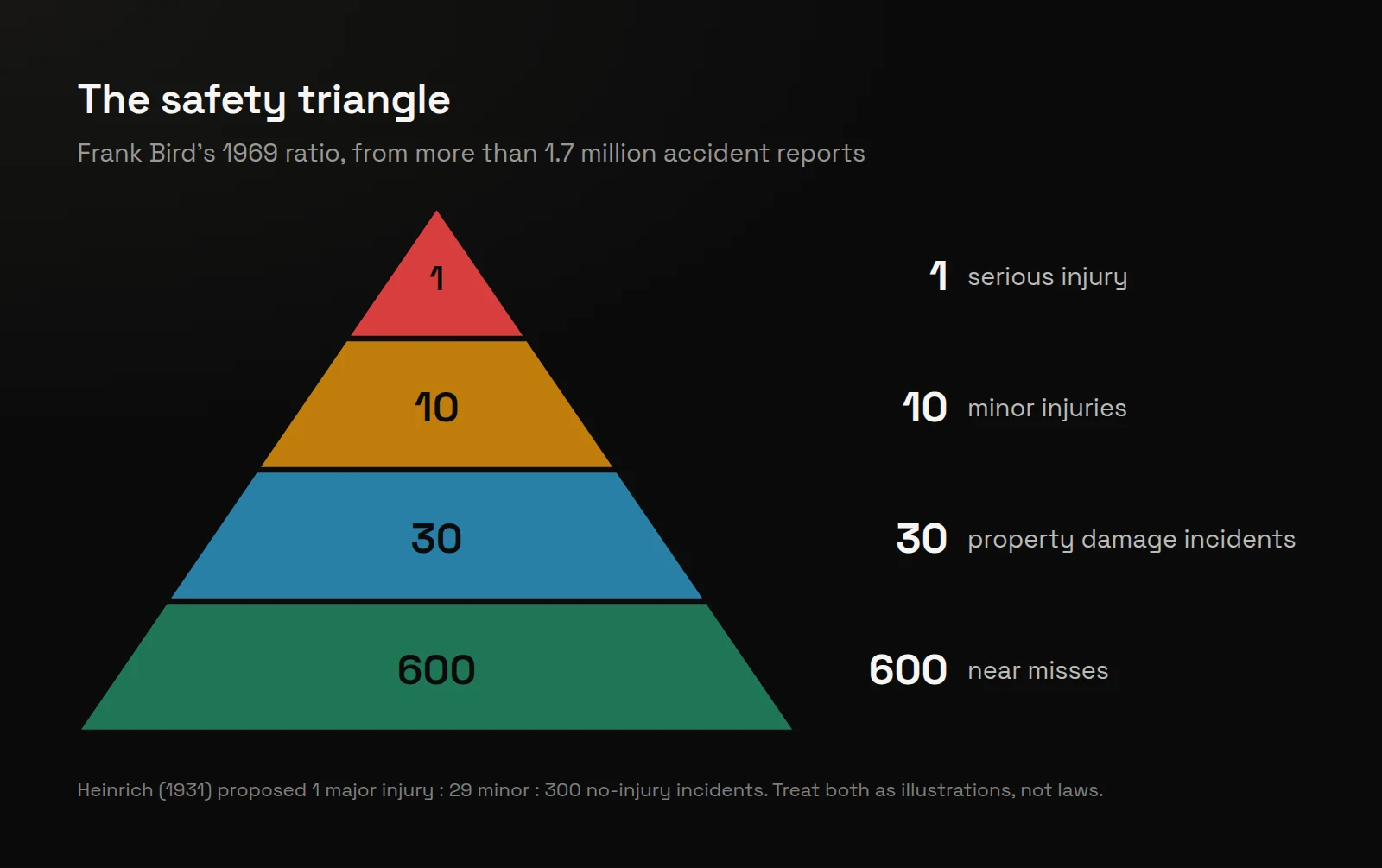
Two classic studies tried to answer this:
- Heinrich (1931) estimated that for every 1 major injury there were 29 minor injuries and 300 incidents with no injury.
- Bird (1969), analysing more than 1.7 million accident reports, put the ratio at 1 serious injury : 10 minor injuries : 30 property-damage incidents : 600 near misses.
Treat these as illustrations, not laws. Modern safety research points out that the causes of serious and fatal injuries are often different from the causes of minor ones, so a falling count of minor injuries doesn't guarantee fewer serious ones. The useful lesson stands: serious accidents sit on top of many smaller events, and the more of those you see and fix, the fewer surprises you get.
Leading vs lagging safety KPIs
Most factories report lagging indicators — they count harm after it happens:
Lost-time injury frequency rate (LTIFR) =
  lost-time injuries × 1,000,000 ÷ hours worked
Frequency per million hours worked is the basis used in Indian practice (IS 3786). It's essential, but by the time it moves, someone is already hurt.
Leading indicators measure the things that come before harm:
| Leading KPI | What it tells you |
|---|---|
| Near misses reported per month | Whether people feel safe reporting; low numbers usually mean under-reporting |
| Unsafe acts observed per 1,000 hours worked | How often risky behaviour happens |
| Unsafe conditions open, and days to close | Whether hazards are fixed or just logged |
| PPE compliance rate by zone and shift | Where rules are and aren't followed |
| Safety observations and audits completed | Whether supervisors are actually looking |
The problem with leading indicators is data. Supervisors can't watch every zone on every shift, and people rarely report their own unsafe acts.
How cameras catch unsafe acts and conditions
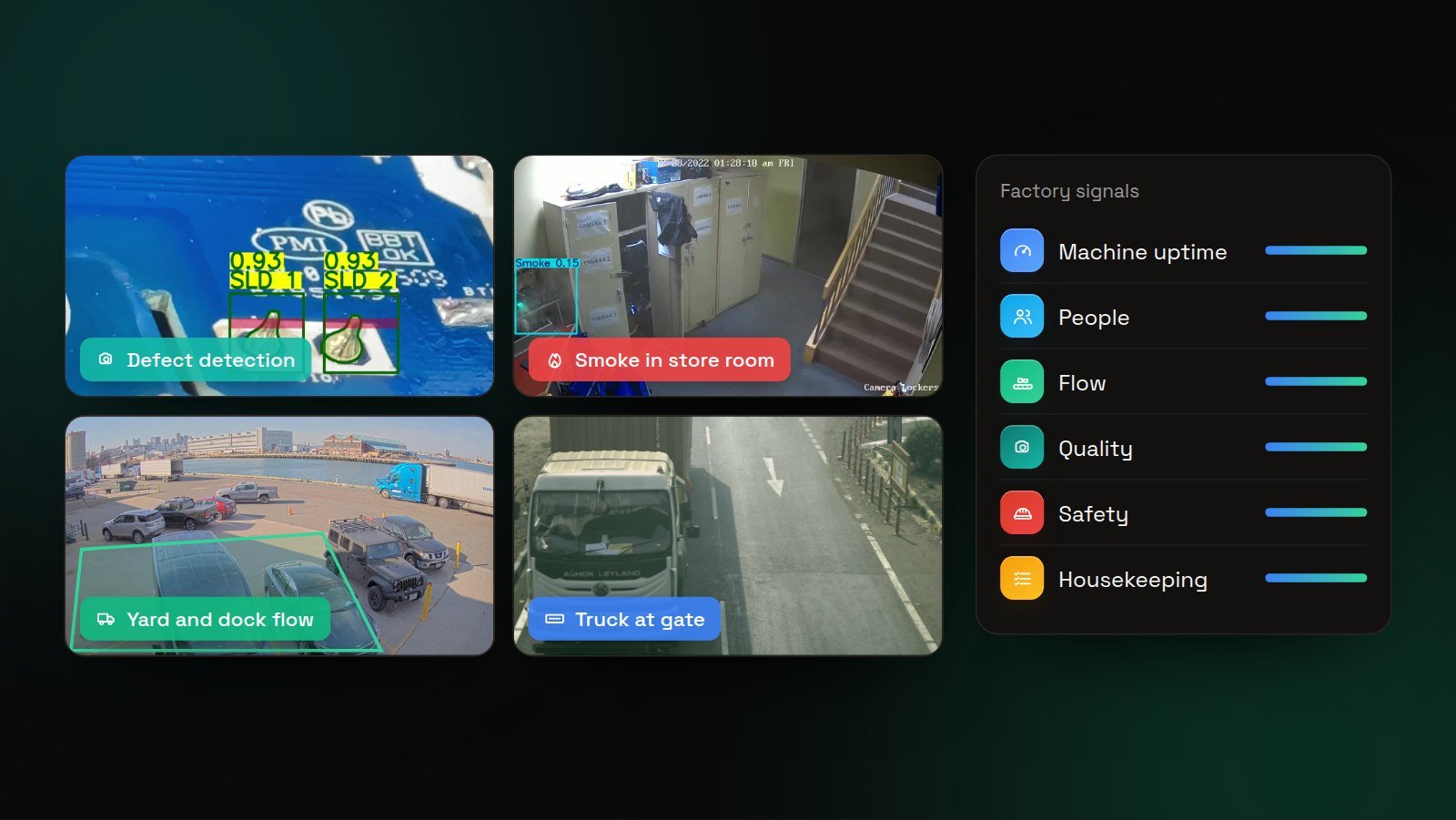
AI video analytics on the CCTV cameras already in the plant can watch every zone, every shift, and log what it sees:
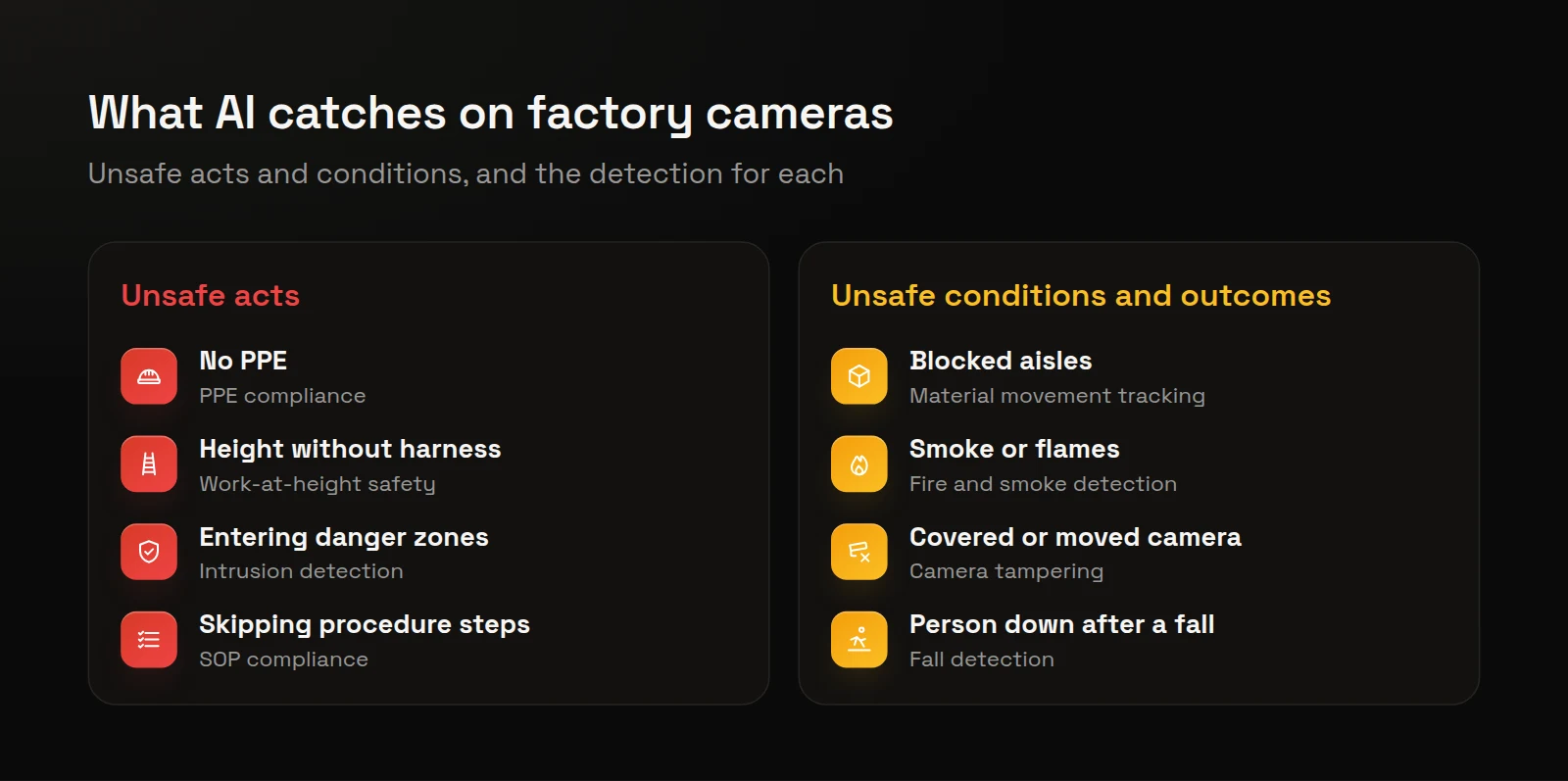
| What happens | Type | AI detection |
|---|---|---|
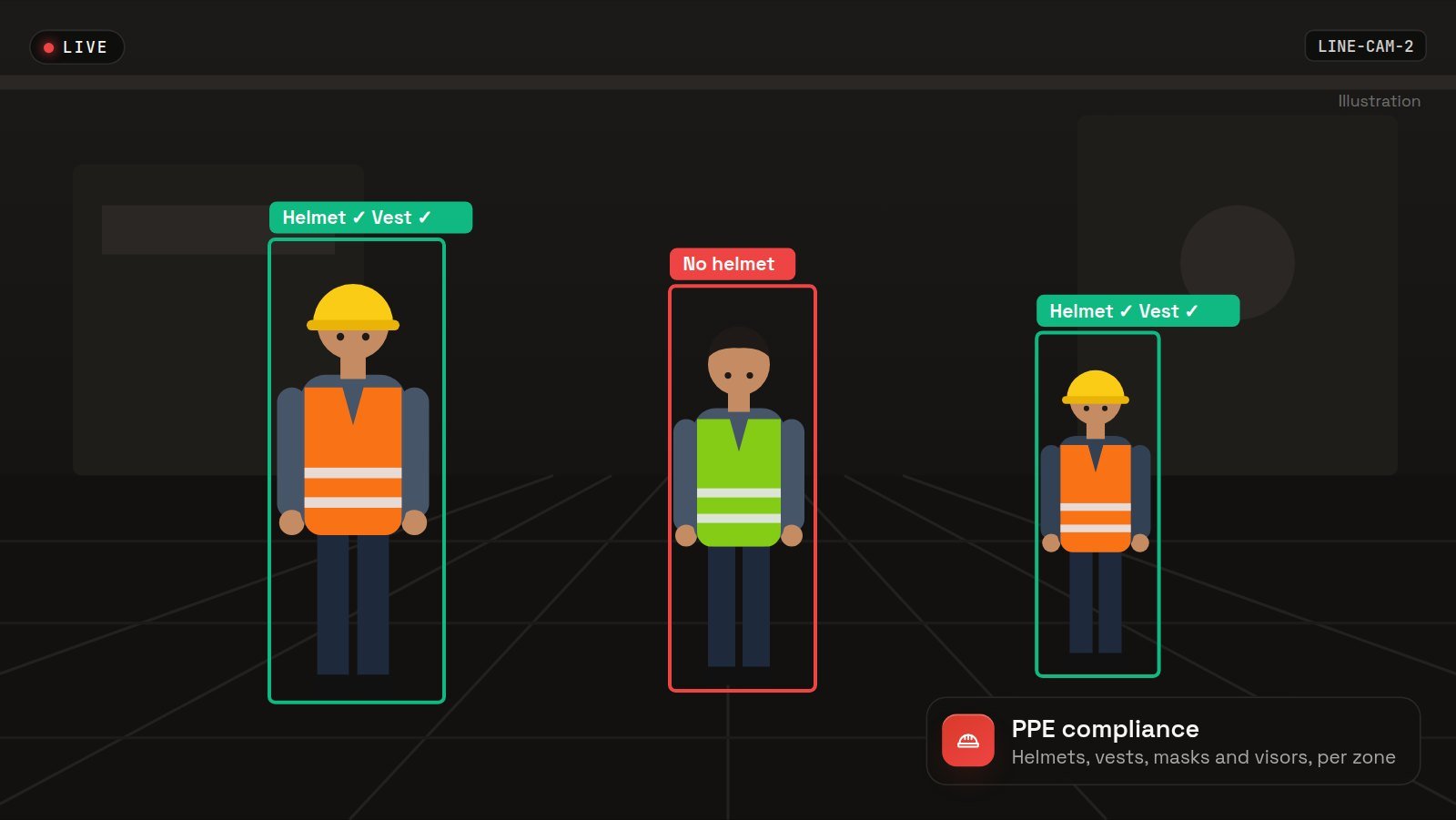
| No helmet, vest, mask or visor | Act | PPE compliance |
| Work at height without a harness | Act | Work-at-height safety |
| Person in a robot cell or press area | Act | Intrusion detection |
| Person falls or lies on the floor | Outcome | Fall detection |
| Blocked aisles and staging areas | Condition | Material movement tracking |
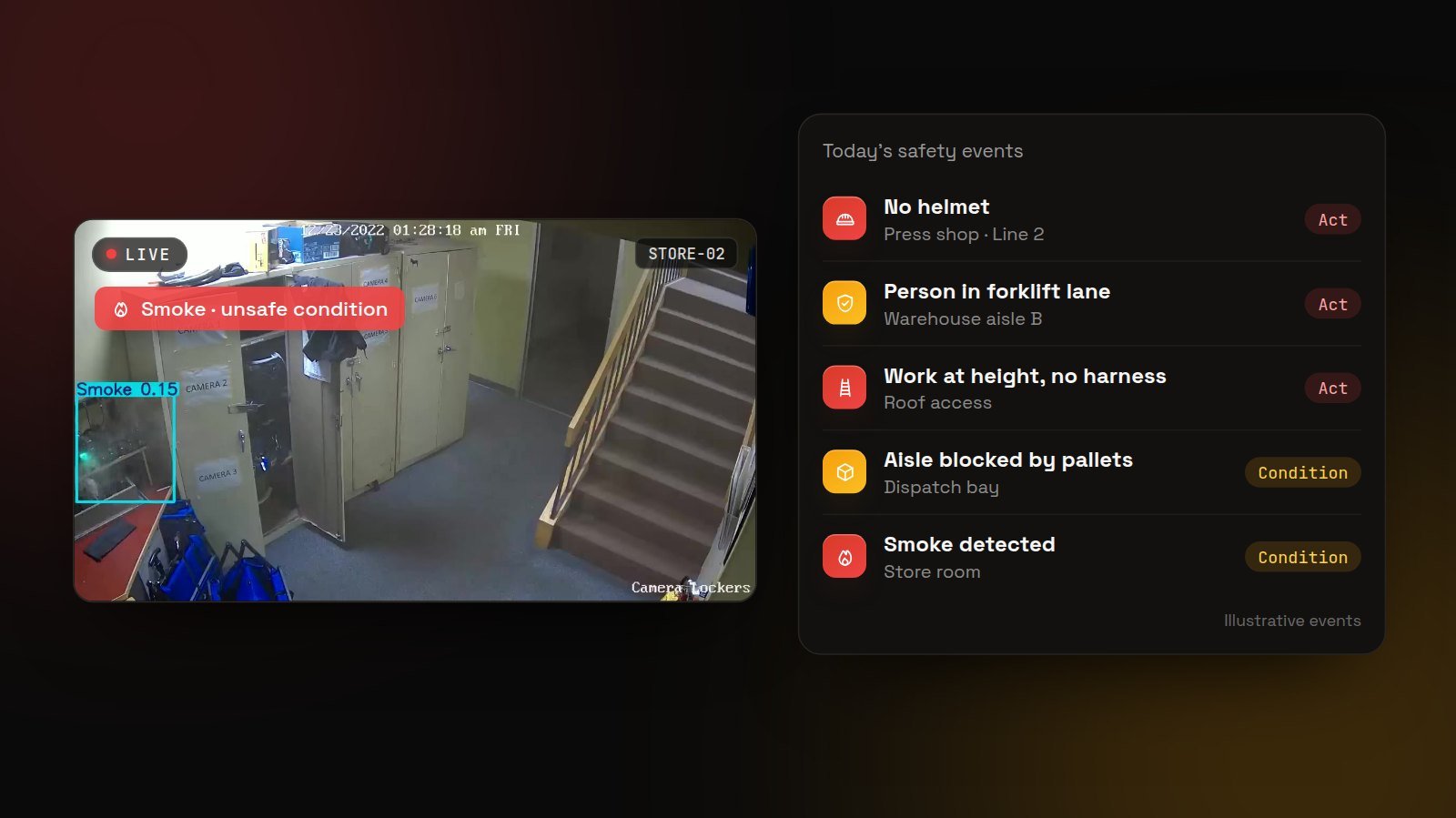
| Smoke or flames | Condition | Fire and smoke detection |
| Procedure steps skipped | Act | SOP compliance |
| Covered or turned-away camera | Condition | Camera tampering |
Each event comes with a snapshot or clip, a time and a zone, which does three things paper systems can't: it turns unsafe acts into a countable leading indicator, shows where and when they cluster (one gate, one shift, one contractor), and gives supervisors something concrete to coach with.
Note Use camera data to fix systems and coach people, not to punish individuals. If workers feel watched for blame, near-miss reporting drops — and you lose the most valuable safety data you have. Tell people what's monitored and why, and share the trends.
Putting it into practice
- Map your top risks. Use your incident and near-miss history to pick the three unsafe acts or conditions that matter most.
- Check camera coverage of those areas. Most plants already have cameras there; some need re-angling.
- Pilot AI detection on those cameras for two to four weeks, and agree who responds to each alert.
- Report weekly on the leading KPIs — unsafe acts per zone and shift, conditions open and closed — alongside your LTIFR.
- Close the loop. Every recurring unsafe act points to a condition to fix: a missing walkway, a slow process, a PPE station in the wrong place.
OCCULAX brings safety together with uptime, people, flow, quality and housekeeping in one Factory Health Score for each plant. See how Arthbot works for manufacturing, read 12 real uses of AI in manufacturing, or book a demo.
Frequently asked questions
What is the difference between an unsafe act and an unsafe condition?
An unsafe act is something a person does that creates risk, such as not wearing PPE or entering a restricted zone. An unsafe condition is a hazard in the workplace itself, such as a blocked exit, a spill or a missing guard.
What are examples of unsafe acts?
Working without required PPE, working at height without a harness, walking in forklift lanes, bypassing machine guards or lockout, using a phone while operating machinery, unsafe lifting and taking shortcuts through restricted areas.
What are examples of unsafe conditions?
Blocked aisles and exits, spills and wet floors, missing guards or railings, poor lighting, overloaded racks, exposed wiring and uncontrolled fumes or dust.
What is a near miss?
A near miss is an unplanned event that could have caused injury, illness or damage but didn't — for example, a falling object that just misses someone. Reporting and investigating near misses helps prevent the accidents they foreshadow.
How many near misses happen before an accident?
Frank Bird's 1969 study suggested about 600 near misses for every serious injury, and Heinrich's earlier work 300 no-injury incidents per major injury. These ratios are illustrations rather than fixed rules, but they show that serious accidents are preceded by many smaller warning signs.
How can CCTV improve workplace safety?
With AI video analytics, CCTV cameras can detect unsafe acts and conditions — missing PPE, people in danger zones, work at height without a harness, falls, smoke and blocked aisles — and alert supervisors in real time with evidence, turning everyday risks into measurable leading indicators.
- worker safety
- EHS
- near miss
- unsafe act
- factory
- safety KPI
See it on your own cameras
Send us a few minutes of your footage and we'll show you what Arthbot finds in it.