Blog7 min read
How does ANPR work? Accuracy and camera setup explained
How automatic number plate recognition reads a plate in five steps, what really decides its accuracy, and how to set up cameras that read Indian plates.

Arthbot team
Arthbot Systems, Haridwar
On this page
Automatic number plate recognition (ANPR) turns a camera into a reader that logs every vehicle by its registration number. It runs gates, car parks, toll lanes and traffic enforcement. Most problems people have with it come from the camera, not the software.
Quick answer ANPR works in five steps. A camera captures the vehicle, AI finds the number plate in the frame, character recognition reads it, the reading is checked against plate formats and other frames, and the result is matched against a list or logged. Accuracy depends mostly on camera setup: at least 100–150 pixels across the plate, a viewing angle under about 30°, a fast shutter for moving vehicles and infrared lighting at night.
ANPR, LPR and ALPR: same thing
ANPR (automatic number plate recognition) is the term used in India and the UK. LPR (license plate recognition) and ALPR (automatic license plate recognition) are the American names for the same technology. "ANPR camera" usually means a camera built or set up specifically for reading plates.
How ANPR works, step by step
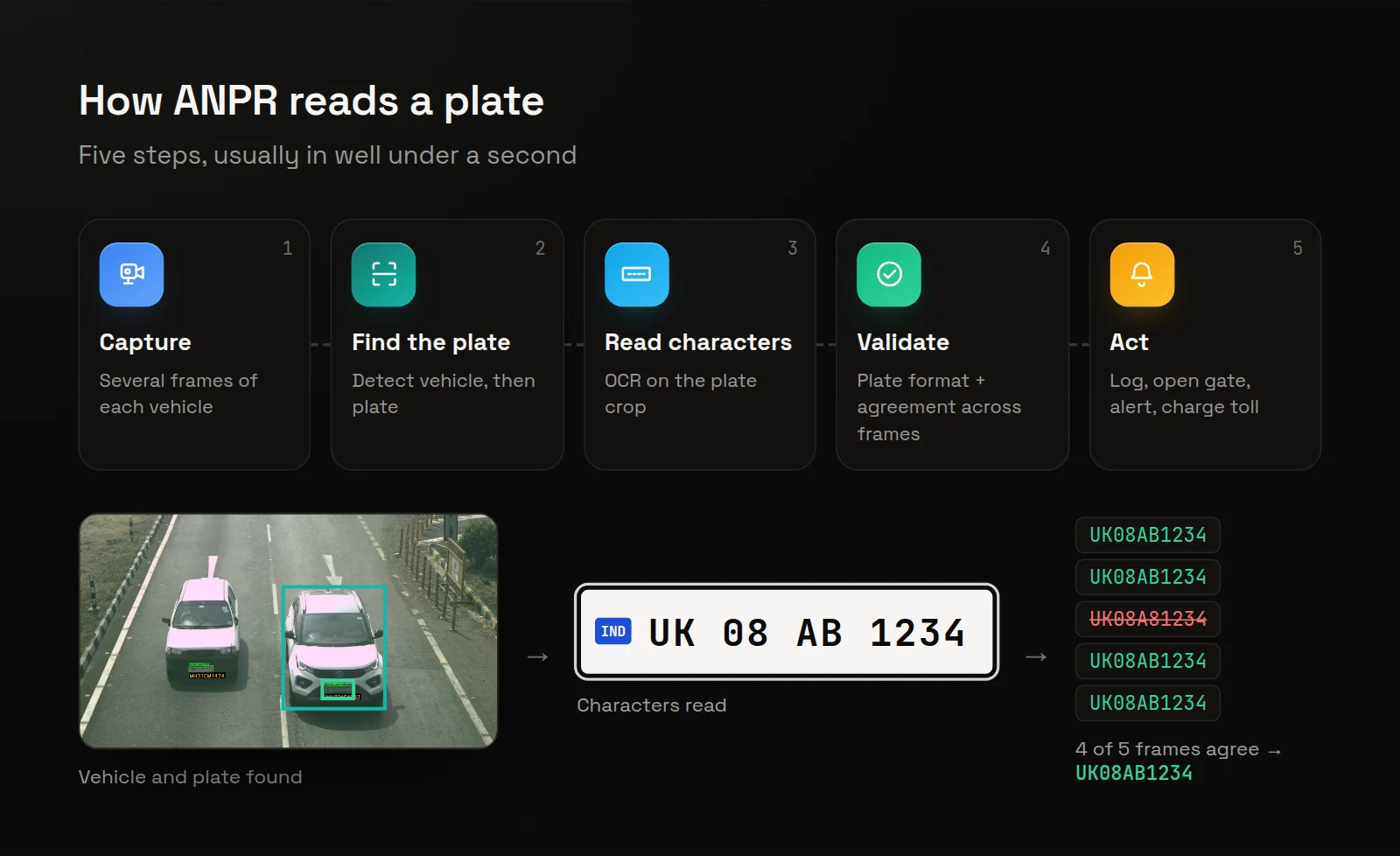
- Capture. A camera records the vehicle. For moving traffic, it takes several frames of each vehicle as it approaches.
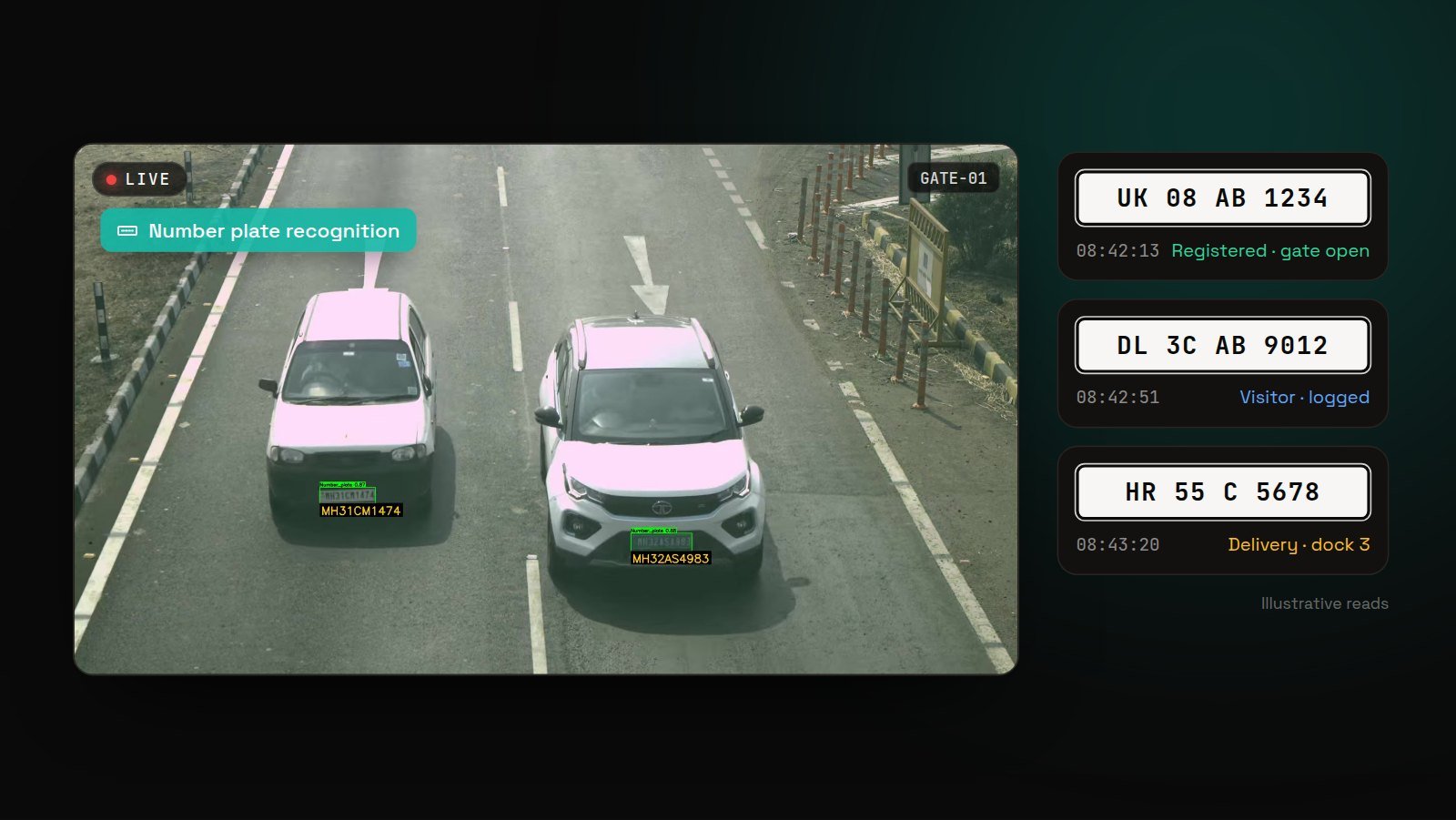
- Find the plate. A detection model locates vehicles, then the plate on each vehicle, and crops it out. Modern systems use deep learning here, which copes with plates at an angle, in different positions and partly dirty.
- Read the characters. Optical character recognition (OCR) — today also a neural network — reads the characters on the crop. Indian plates add their own challenges: two-line plates on two-wheelers and commercial vehicles, BH-series plates, and non-standard fonts on older plates.
- Validate. The reading is checked against valid plate formats (state code, district number, series, number) and compared across several frames of the same vehicle. A plate read the same way in five frames is far more reliable than one read once.
- Act. The plate is logged with a timestamp, image and camera, and matched against lists: open the gate for a registered vehicle, alert on a watchlisted one, start a parking session, or charge a toll.
What decides ANPR accuracy
Vendors quote accuracy figures of 95–99%, measured in good conditions. What you actually get depends on these factors, roughly in order of importance:
| Factor | What good looks like | Why it matters |
|---|---|---|
| Pixels across the plate | At least 100–150 px across the plate's width | Too few pixels and characters such as 8/B or 0/D merge |
| Viewing angle | Under about 30° horizontally and vertically | Steep angles squash characters |
| Shutter speed | 1/1000 s or faster for moving vehicles | Slow shutters blur plates at speed |
| Night lighting | Infrared, matched to the distance | Headlights otherwise flare the plate out |
| Plate condition | Clean, standard font, undamaged | Mud, stickers, fancy fonts and bent plates cause misreads |
| Lanes per camera | One or two lanes for a 1080p camera | Wider views spread pixels too thin |
The pixel and angle figures come from camera makers' published guidance, such as Axis's licence plate capture guide. They're the same whichever ANPR software you use.
India's High Security Registration Plates (HSRP), mandatory on new vehicles since 2019, help a lot: their retro-reflective sheeting shines brightly under infrared light, and the standard font is easier to read. Older plates with custom fonts, regional-language characters or dirt remain the main source of errors.
Tip Ask any vendor to measure accuracy on your footage, at night and in the rain, not on a demo clip. Count both how many vehicles produced a read (capture rate) and how many reads were fully correct (read accuracy). Multiply the two for the figure that matters.
How far can an ANPR camera see?
Distance depends on the lens: a zoom lens can put a plate-sized view 5 m or 40 m away. The real limits are pixel width, angle and infrared range. The pixel rule tells you how wide a scene one camera can cover:
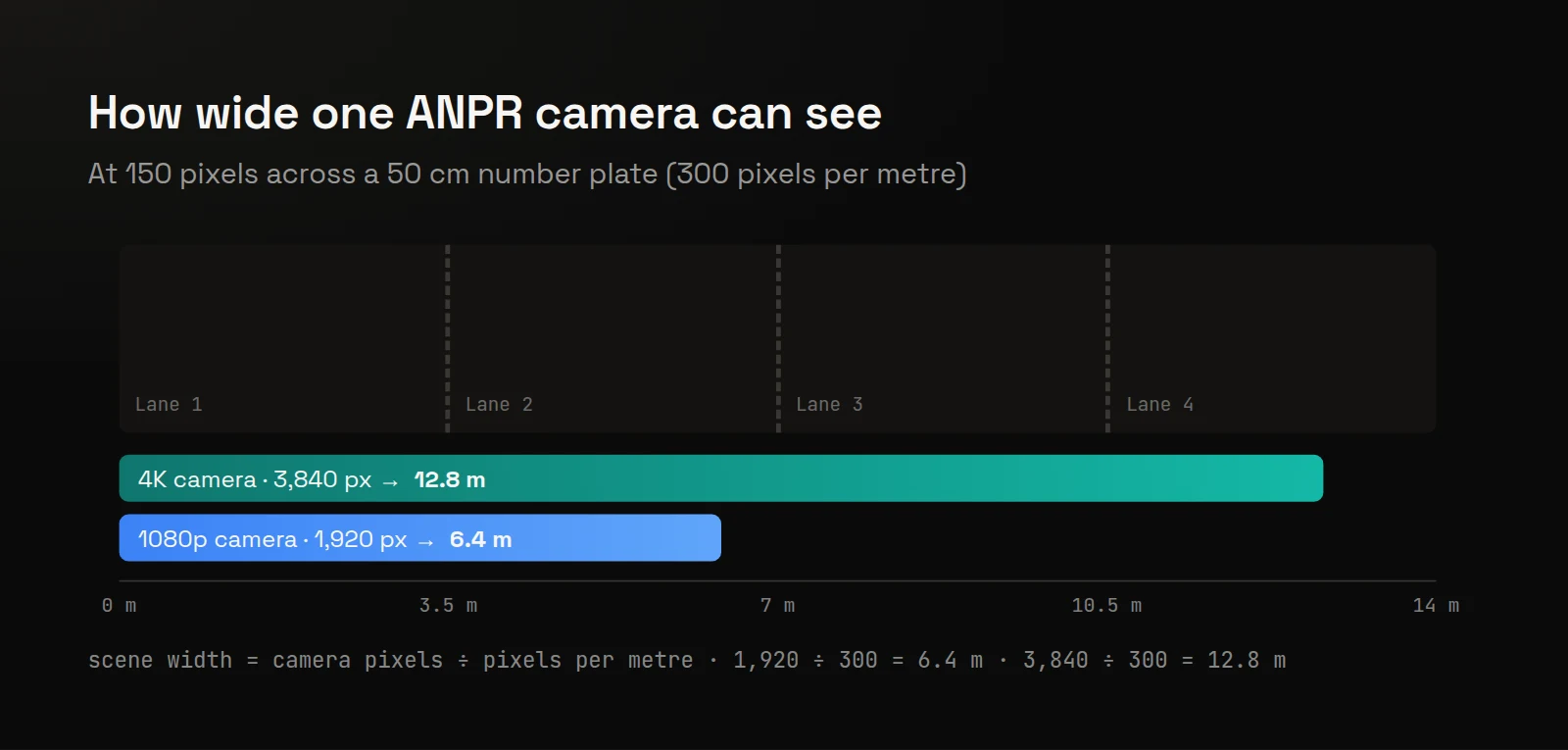
Pixels per metre needed = pixels across plate ÷ plate width
Scene width covered     = camera's horizontal pixels ÷ pixels per metre
A car plate in India is about 50 cm wide. For 150 pixels across it you need 300 pixels per metre, so a 1080p camera (1,920 pixels wide) covers about 6.4 m — just under two 3.5 m lanes. A 4K camera (3,840 pixels) covers about 12.8 m, three to four lanes. That's why gates use one camera per lane and highways use one camera per one or two lanes.
Can a normal CCTV camera do ANPR?
Often, yes — if the pixels, angle and shutter speed work. A 2 MP or 4 MP camera looking along a gate lane, mounted low and close, can read plates well by day. Where ordinary cameras fall short:
- Wide views. A camera covering a whole car park won't have enough pixels on any one plate.
- Night. Without strong, focused infrared lighting, headlights wash out plates.
- Speed. Auto-exposure picks slow shutters in low light, blurring moving plates.
Dedicated ANPR cameras solve these with narrow lenses, fast shutters and powerful infrared lighting. A common, cost-effective approach is to use existing cameras where vehicles slow down — gates, barriers, drive-throughs — and add dedicated ANPR cameras only on fast roads.
Arthbot's ANPR runs on both: existing CCTV and dedicated ANPR cameras feed the same system, which logs every vehicle, flags watchlisted plates and makes every plate searchable across cameras.
Where ANPR is used
- Gates and parking: automatic entry for registered vehicles, visitor logs, parking time and fees. See smart parking management.
- Logistics yards and docks: truck arrival and departure times, turnaround and dock scheduling. See dock management.
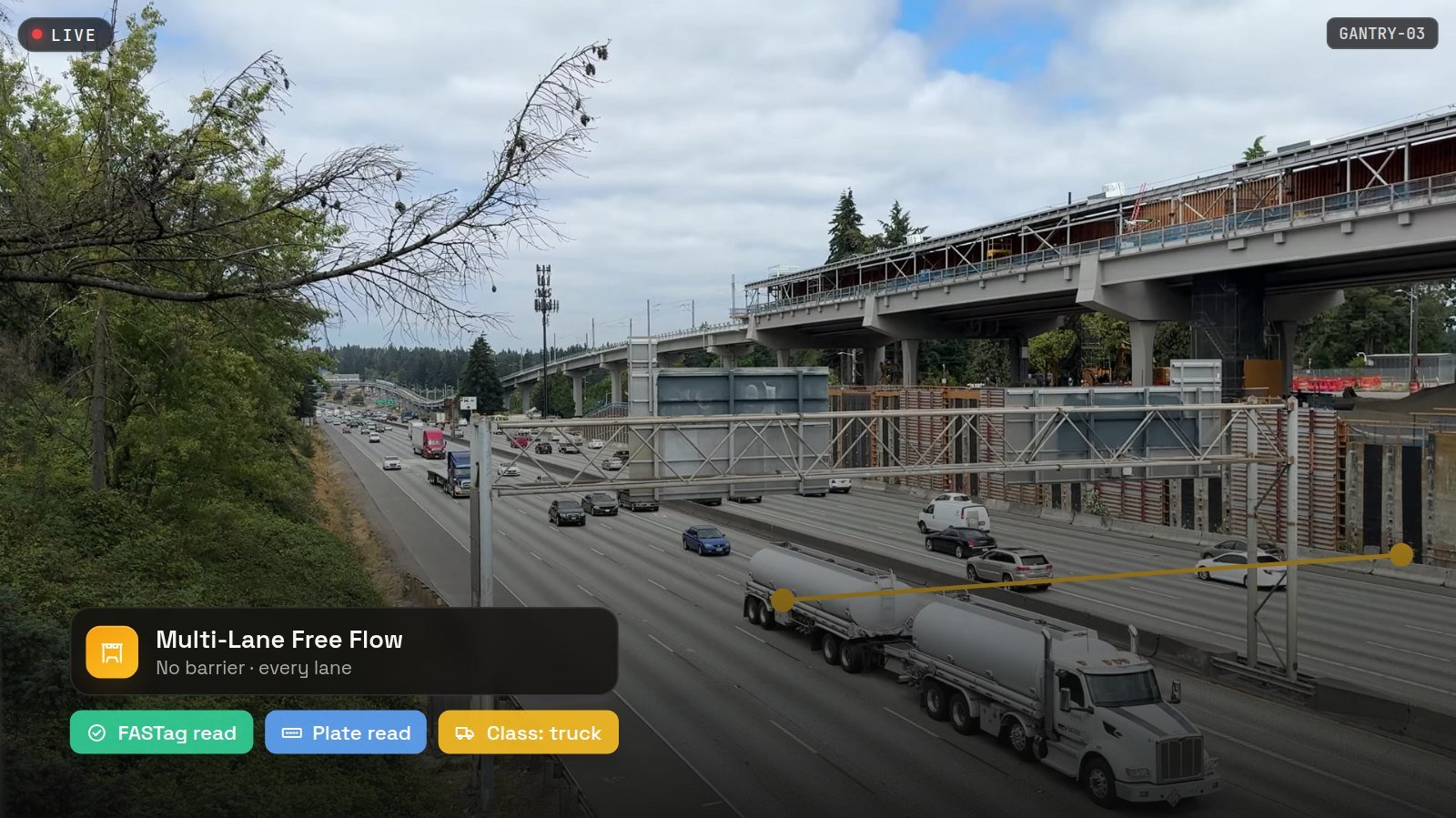
- Tolling: reading every vehicle in free-flow toll lanes — see What is MLFF tolling?
- Traffic enforcement: red-light, speed and wrong-way violations with plate evidence. See traffic violation detection.
- Fuel stations, campuses and hotels: repeat-visit recognition, watchlists for drive-offs and VIP arrivals.
ANPR and privacy
A number plate linked to an owner is personal data under India's Digital Personal Data Protection Act, 2023. Collect plates for a clear purpose, tell people (signage at gates is the usual way), restrict who can search the records, and delete them when that purpose is served. Good ANPR systems make these controls part of the setup rather than an afterthought.
Frequently asked questions
How does ANPR work?
A camera captures the vehicle, an AI model finds the number plate in the image, character recognition reads it, the reading is checked against valid plate formats and across several frames, and the plate is logged or matched against a list to trigger an action such as opening a gate.
How accurate are ANPR cameras?
Well-installed ANPR systems read most plates correctly in good conditions, and vendors often quote 95–99%. Real accuracy depends on pixels across the plate, viewing angle, shutter speed, night lighting and plate condition, so test on your own footage, including at night.
What is the difference between ANPR and LPR?
None. ANPR (automatic number plate recognition) is the British and Indian term; LPR or ALPR (automatic license plate recognition) is the American term for the same technology.
Can a normal CCTV camera read number plates?
Yes, if it has enough pixels on the plate (about 100–150 across its width), sees the plate at a shallow angle and uses a fast enough shutter. Ordinary cameras work well at gates and barriers where vehicles slow down; fast roads and night-time reading usually need dedicated ANPR cameras.
How far can an ANPR camera read?
As far as its lens, infrared lighting and angle allow — often 5 to 30 metres. What matters is the width of the scene: a 1080p camera covers about one to two lanes at 150 pixels per plate, a 4K camera about three to four.
Is ANPR legal in India?
Yes. ANPR is widely used on highways, in cities and at private sites in India. Because plates linked to owners are personal data, private operators should follow the Digital Personal Data Protection Act: a clear purpose, notice, limited access and deletion when no longer needed.
- ANPR
- LPR
- number plate recognition
- traffic
- gate automation
See it on your own cameras
Send us a few minutes of your footage and we'll show you what Arthbot finds in it.